



NEWS EVENTS
4 Steps - The Complete Guide to 3D Printing Wax
2026-02-24
01 Why
For thousands of years, metalworkers have used beeswax to hand-carve tool models or other items. The wax model is wrapped in a material to harden the area around it. When the wax melts, the hardened shell becomes a mold into which liquid metal is poured.
Today, this process is known as investment casting, or lost-wax casting as jewelers call it. It has not changed much except that the speed and customizability of 3D printing wax and wax pattern casting materials have been greatly improved now.
Instead of making models or patterns through injection molding or carving, parts are designed using Computer-Aided Design (CAD) software and directly 3D printed in wax. There are specialized software programs for industrial, dental, and jewelry casting, so you don’t need profound design skills. Existing parts can also be reverse-engineered through 3D scanning and uploaded to CAD software.
3D printing of wax models is becoming the preferred method in many industries. Last year, the study "3D Printing Jewelry Market 2023: Market Research and Forecast" showed that by 2031, the 3D printing jewelry market will reach 989 million US dollars, compared with 489 million US dollars in 2021.
Wax models can reduce casting costs by up to 95%.
There are three different types of 3D printing used to make wax models.
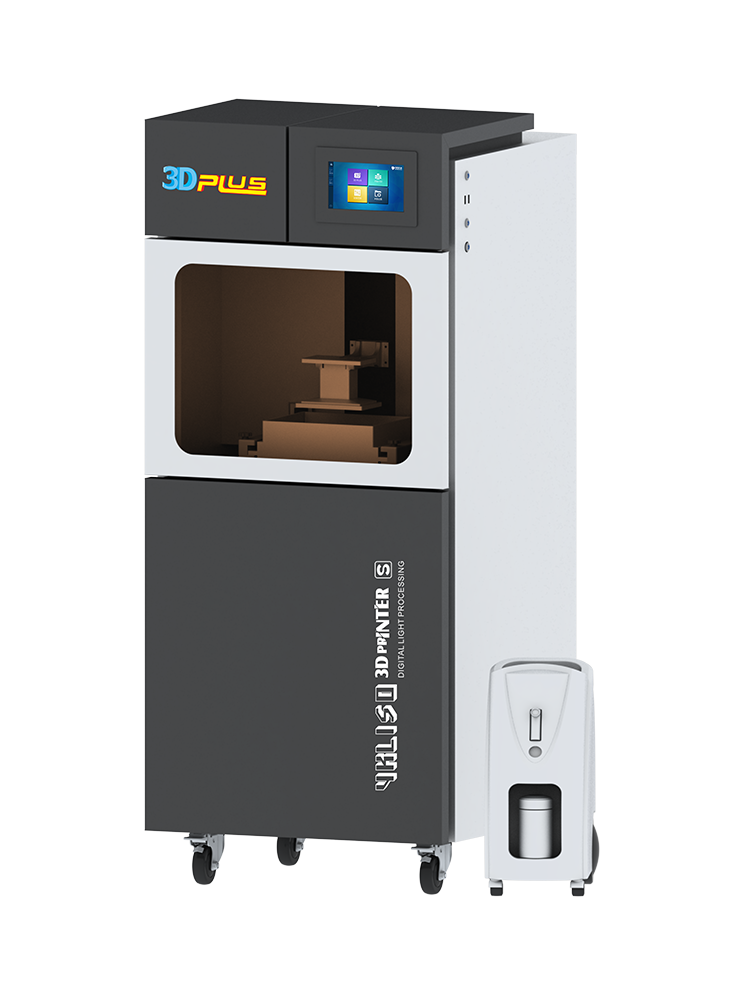
For jewelry and small-size, small-batch 3D printing, desktop vat photopolymerization printers are the most typical because they can create detailed models. This is achieved through vat photopolymerization technologies such as Stereolithography (SLA), Masked Stereolithography (MSLA), or Digital Light Processing (DLP). Vat photopolymerization can also be used for larger industrial wax models or sculptures with industrial-scale printers. This process requires several post-processing steps, and it is crucial to follow the material manufacturer’s guidelines to prepare the model for investment casting.
Material jetting is another 3D printing technology that deposits wax-like materials and cures them immediately under ultraviolet light. It is usually much faster than vat photopolymerization. One type of material jetting is called Drop-on-Demand (DOD). This technology uses two print heads to print two different materials: one is the main material of the part, and the other is a soluble support material that dissolves in a liquid solution, leaving only a smooth model. This further simplifies the process because there is no need to manually remove the supports.
Under this technology, there are industrial machines that can print dozens of models at once or very large models, such as 3D Systems’ ProJet MJP 2500W Plus. With a maximum build envelope of 294 x 211 x 144 millimeters, this machine is one of the fastest and most productive 3D printers specifically designed for jewelry manufacturing. Using the newly launched ZHD printing mode, it can achieve printing with a layer thickness of 8µm, delivering best-in-class surface quality.
Wax-like models can also be made on classic FDM 3D printers using wax-like filaments, enabling FDM printers to produce mold castings. This is the most economical option, but the model will require some post-processing, such as sanding to remove layer lines.


02 All About
As we mentioned above, All3DP covers the technologies, processes, and printers for mold making (for jewelry and industry) in other guides. What we are talking about here is wax, castable resin, and other materials used for casting. This is different.
You can print with pure wax, but newer materials, such as castable resin, are stronger, cleaner during the casting process, and have other advantages.
For example, Polymethyl Methacrylate (PMMA) is an acrylic plastic with excellent burnout performance and is often used in industrial casting. These materials are not always suitable as direct substitutes for wax because some may have negative interactions with phosphate-bonded and gypsum-bonded investment materials. Ensure that your casting material is compatible with your investment material.
Your 3D printer may only be compatible with wax materials manufactured by your 3D printer’s manufacturer, such as Formlabs or the recently discontinued Solidscape printers. If your printer is compatible with third-party materials, please pay attention to the following when purchasing wax materials:
Melt Time: How long does it take for your wax or castable resin material to completely melt or burn out of the mold?
Ash Level: Wax materials with low or no ash will leave little or no residual ash inside your mold, while other wax materials may require you to thoroughly clean the mold.
Low shrinkage: All waxes and castable materials will shrink, and you need to take this into account, so it is important to know the shrinkage rate, which should be listed on the material’s technical data sheet.
Low water absorption: Most castable resins will absorb moisture if not covered, so they need to be stored in a cool, dry place.

03 Wax Filament
Wax-based and castable filaments can also be used in your FDM 3D printer. When used for casting molds, these formulations outperform conventional PLA. Although you can use low-cost PLA, PLA will leave residues in the mold and will not melt.

04 Top Wax Printers
3D wax printing can be used in any industry involving the casting of metals or plastics. Each industry has its own specifications and therefore different requirements for the machines they prefer to use. The requirements for casting metal jewelry are vastly different from those for producing molds for medical devices or aircraft propellers. Below are some recommendations for choosing the best printer by industry category.
Jewelry
Printing jewelry requires machines that can produce one detailed master wax model or several detailed models at a time. Speed is crucial for the machine to quickly produce different iterations, especially when your bestselling designs are in mass production.
Most jewelers choose resin-based technologies, including SLA, LCD, or DLP, because of their high printing resolution and the availability of waxes and castable resins that burn out cleanly during washing.
Material jetting is another resin technology that is usually faster than SLA and LCD, especially for mass production. Using material jetting, such as 3D Systems’ ProJet 2500W series 3D printers, layer thicknesses as thin as 8 microns enable extremely fine detail resolution.
Dentistry
Working in the dental industry is somewhat more complex than in other industries. Any dentist or dental laboratory professional knows that there is a world of difference between dental models used for patient education and dental parts used by patients.
If your goal is to print a fairly accurate model of a patient’s mouth from an oral 3D scan or impression, for example, to explain a procedure to the patient, then a specialized dental printer is not needed. However, in the real world, dentists need to produce 3D printed models that precisely match the patient’s teeth and gums when treating patients. Moreover, if you want to print biocompatible dental parts—anything that will come into contact with the patient’s mouth or skin—you need to use biocompatible materials certified by local regulatory authorities, along with approved software and 3D printers.
Printers such as Shining 3D’s AccuFab-L4D, AccuFab-D1s, Desktop Health’s Einstein series, Carima’s IMD, and several DLP printers from Rapid Shape are capable of printing dental products. Stratasys’ J5 DentaJet and new J3 DentaJet are equipped with a full range of biocompatible dental resins. In addition, the Separator DM automatically coats dental models to simplify the separation of acrylic appliances from the models, followed by the removal of wax and residues.
Industrial 3D Printing of Casting Patterns
Some industries need to produce parts through casting. From aerospace to automotive, from military to medical, many industries have turned to 3D printing to produce molds, cores, and patterns to optimize and modernize their workflows and reduce costs. When it comes to wax and casting material printers, several 3D printer manufacturers stand out, namely 3D Systems, Voxeljet, and Eplus3D.
3D Systems manufactures a wax 3D printer that is ideal for industrial pattern making. 3D Systems also offers a process called QuickCast on its Stereolithography (SLA) 3D printers, using the special material Accura Fidelity, which features build styles provided by the company’s 3D Sprint Pro additive manufacturing software. The company states that this process can create complex master patterns in hours that are large, lightweight, and strong enough for use in the investment casting process.
Eplus3D’s EP-C7250 uses what the company calls "resin sand" to print sand molds for the metal casting of parts such as engine blocks, cylinder heads, turbines, and impellers with complex structures. This printer uses Selective Laser Sintering (SLS), offers a large build size, and can quickly print sand castings and molds from powdered wax, polystyrene, or resin sand to create molds for traditional casting processes.


END
Disclaimer: This news information is sourced from the internet. If there is any infringement, please contact us for removal. cn@totustec.com
Keywords:
Related News





F2 Building 6A Jintong National Industrial Park No.8 Xihu Road Wujin District Changzhou City Jiangsu Province China
Follow Us



language
English
العربية
বাংলাদেশ
Български
Hrvatski
Česky
Dansk
Nederland
Esperanto
Slovenski
filipino
Suomi
Français
Maori
Georgian
Deutsch
Ελλάδα
ישראל
इंडिया
Magyarország
Ísland
Indonesia
Irlanda
Italia
日本語
Sovensko
Հայաստան
한국
Kyrgyz
ປະເທດລາວ
Latvian
Lithuanian
Luxembourgish
Macedonian
Малайская
Maltese
Монгол улс
ဗမာ
नेपाल
Norge
ایران
Polska
Portugal
România
Российская
Србија
Србија
Bosanski
Slovenian
Беларус
España
Sverige
Точик
ประเทศไทย
Türk
Azərbaycan
Uzbek
Việt Nam
Copyright © 2022 Jiangsu Totustec. All Rights Reserved. 苏ICP备17013684号-1 Powered by:www.300.cn SEO

Online Message
 Message
  cn@totustec.com
 +86 18112582262